How Taxi Audio Advertising Is Changing Digital Audio Advertising in 2026
May 26, 2026

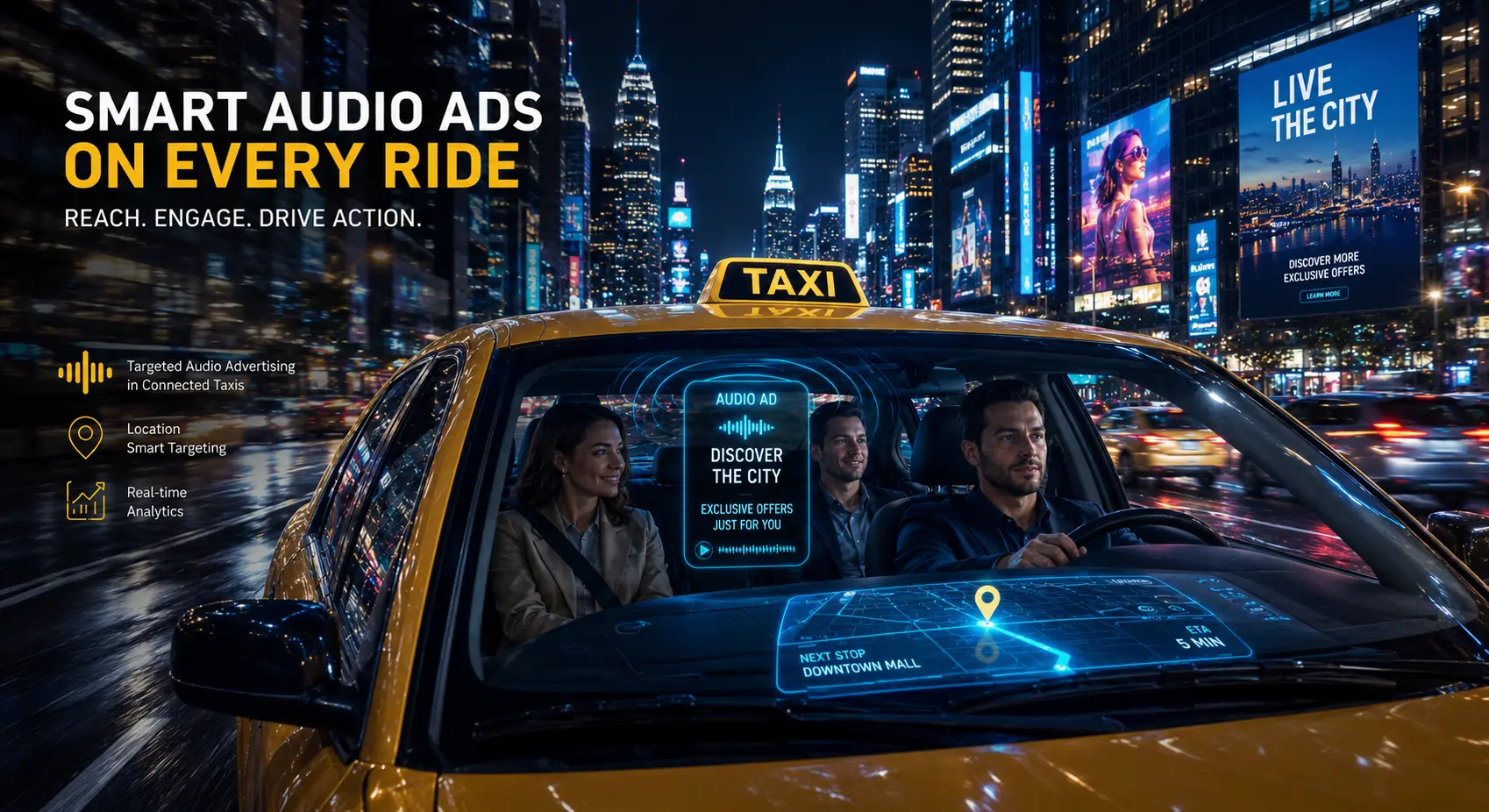
May 26, 2026
Quick answer: Taxi Audio Advertising transforms digital audio advertising by delivering geo-targeted, non-skippable audio messages to captive audiences inside rideshare vehicles. In 2026, businesses leverage modern audio advertising platforms to run location-aware campaigns, increasing local brand awareness and customer engagement during daily commutes.
Advertising becomes increasingly mobile and highly personalized in 2026. Consumers spend countless hours in transit, commuting to work, attending events, or exploring their cities. Brands actively search for smarter ways to connect with these audiences during daily travel, moving away from static billboards and easily ignored visual banners.
This shift introduces Taxi Audio Advertising as a rapidly growing segment of digital audio advertising. By delivering high-quality audio messages directly into the passenger cabins of taxis and rideshare vehicles, businesses reach people when they are seated, relaxed, and receptive. Commuters represent a highly valuable audience with specific travel intents, making them ideal targets for localized messaging.
Modern audio advertising platforms now help businesses improve customer engagement through advanced location-tracking and real-time ad delivery. Instead of broadcasting a generic message to an entire city, companies can trigger specific advertisements when a vehicle enters a designated neighborhood.
Managing these dynamic campaigns requires strategy and precision. A professional audio advertising agency simplifies campaign management, helping brands craft the right message, target the right zones, and track performance accurately. Throughout this guide, we will explore exactly how this ecosystem operates and why it matters for your marketing strategy.
Taxi Audio Advertising refers to the strategic placement of promotional audio messages inside commercial passenger vehicles, including traditional taxis and modern ride-share cars. Businesses deliver these audio messages through integrated smart screens or dedicated in-car audio systems.
This format generates stronger attention than traditional visual ads because it utilizes the passenger's auditory environment. When a person sits in a vehicle, their eyes might wander to their phone, but their ears remain tuned to the ambient sound of the car. An audio advertisement plays clearly in this enclosed space, creating an intimate and direct connection with the listener.
This approach fits perfectly into modern digital audio advertising by combining programmatic delivery with physical mobility. Brands achieve real-time customer engagement during rides, connecting with people exactly when they are approaching shopping districts, dining areas, or entertainment venues.
The growth of connected transportation makes smart urban advertising highly effective. Vehicles today function as moving data hubs, equipped with GPS and continuous internet connectivity. Smart mobility marketing trends show that cities and transportation fleets are integrating screens and audio systems to improve the passenger experience, creating new premium inventory for digital audio advertising.
Passengers spend uninterrupted time inside vehicles. A typical urban ride lasts between fifteen and thirty minutes. During this window, commuters experience less distraction compared to scrolling through social media ads. An audio advertisement inside a taxi commands attention without feeling overly intrusive, leading to much higher message retention.
Businesses want targeted and measurable campaigns. Traditional radio offers broad reach but lacks precise targeting. Digital audio advertising provides the exact analytics businesses crave. Audio ads create stronger brand recall because they combine the emotional power of voice with the data-driven precision of modern tech.
Smart audio devices inside taxis connect to central cloud-based networks. These systems handle scheduled ad delivery based on strict parameters set by the advertiser. The technology enables location-aware messaging, meaning an advertisement only triggers when the vehicle meets specific geographic criteria.

Modern audio advertising platforms allow marketers to build highly specific geo-targeted campaigns. A brand can draw digital boundaries (geofences) around a competitor's store or a popular event venue. Time-based promotions also play a crucial role; a coffee shop can play breakfast specials during the morning rush hour. This city-specific marketing ensures the message aligns with the passenger's immediate surroundings.
Advertisers use sophisticated dashboards for ad scheduling and campaign tracking. Real-time campaign management provides instant performance insights. If an audio advertisement underperforms in a specific neighborhood, marketers can immediately adjust the creative or shift the budget to a different zone.

Once a passenger enters a vehicle, they occupy a closed environment. This captive setting guarantees that the digital audio advertising message reaches the listener clearly, free from the noise of crowded streets.
By playing ads relevant to the vehicle's exact location, businesses build immediate local relevance. A passenger hearing an ad for a restaurant just two blocks away is highly likely to remember that brand when making dining decisions.
Unlike massive outdoor billboards that charge flat premium rates regardless of who walks by, Taxi Audio Advertising optimizes ad spend. Advertisers only pay when the audio advertisement actually plays to an active passenger, reducing wasted impressions.
Audio naturally triggers memory and emotion better than static text. A well-crafted audio advertisement with a distinct voice and subtle background music leaves a lasting impression on the commuter.
Passengers cannot skip or fast-forward the audio advertisement. This guarantees a 100% listen-through rate, a metric that remains incredibly rare in mobile and desktop digital audio advertising.
Taxis constantly navigate high-density areas, business districts, and airport terminals. This mobility gives brands unparalleled reach across the most active parts of a city.
Executing a flawless campaign requires more than just recording a voiceover. An audio advertising agency manages comprehensive campaign strategy planning, ensuring every dollar spent aligns with broader business goals. Agencies handle professional audio script creation, writing copy specifically designed to resonate with people in transit.
Agencies also provide better audience targeting by leveraging proprietary data tools. They handle the complex campaign optimization process, monitoring daily delivery to maximize impact. Furthermore, agencies deliver detailed performance tracking and reporting, giving brands clear visibility into their return on investment.
A modern audio advertising agency helps brands create smarter commuter-focused campaigns instead of relying on outdated traditional advertising methods. By partnering with experts, businesses elevate their Taxi Audio Advertising efforts, ensuring the creative matches the sophistication of the technology. For comprehensive support, businesses should explore dedicated [taxi advertising service pages] to understand available options.
Effective audio advertising platforms provide granular data on impression counts, play locations, and time of day. Real-time analytics allow marketers to prove the value of their digital audio advertising investments immediately.
The platform must offer precise geofencing capabilities. Location-based targeting ensures that a business only pays to reach passengers traveling through relevant, high-converting neighborhoods.
Advertisers need the ability to day-part their campaigns. Flexible campaign scheduling lets a nightlife venue run ads exclusively on Friday and Saturday evenings, maximizing relevance.
Advanced platforms analyze route patterns and historical ride data to predict passenger demographics. AI-based audience insights help brands serve the right audio advertisement to the right demographic profile.
Marketers require intuitive interfaces. Easy campaign management tools streamline the process of uploading audio files, setting geographic boundaries, and adjusting budgets on the fly.
Artificial intelligence now generates dynamic scripts and synthetic voices. An AI-powered audio advertisement can automatically insert the current neighborhood name into the audio track, making the message feel hyper-local.
Brands increasingly tailor their digital audio advertising to specific commuter behaviors. For example, morning commuters hear fast-paced, energizing ads, while evening passengers hear relaxing, leisure-focused messages.
Mapping technologies continue to become more precise. Geo-targeted Taxi Audio Advertising in 2026 triggers ads based on micro-locations, such as a vehicle stopping at a specific traffic light near a retail store.
Taxi audio systems now synchronize with broader city infrastructure. Smart city advertising integration allows taxi ads to coordinate with nearby digital billboards, creating a unified omnichannel experience.
Businesses base every decision on concrete transit data. Data-driven digital audio advertising removes the guesswork, ensuring that brands reach audiences with mathematical precision.
Understanding the difference between these formats helps businesses allocate budgets effectively.
Feature
Taxi Audio Advertising
Traditional Advertising
Audience Reach
Targeted audience reach based on routes
Broad audience targeting with high waste
Data Tracking
Real-time analytics and impression counts
Limited tracking and estimated views
Location Relevance
Location-based engagement
Static advertising bound to one place
Engagement Levels
Better commuter attention in a captive space
Lower engagement due to high distraction
Campaign Agility
Smart digital optimization on the fly
Traditional campaign setup with long lead times
Certain sectors see outsized returns from engaging commuters. Local businesses use this format to drive immediate foot traffic. Restaurants and food delivery services capture the attention of hungry passengers heading home after a long workday.
Healthcare clinics use geo-targeting to reach residents within a specific radius of their facilities. Real estate brands advertise new developments to passengers traveling through affluent or up-and-coming neighborhoods. Events and entertainment businesses promote concerts to riders heading toward downtown districts. Finally, retail and e-commerce companies utilize a professional audio advertising agency to drive app downloads and weekend sales.
While highly effective, marketers must navigate several specific hurdles. Maintaining ad relevance requires constantly updating creative assets so frequent riders do not experience ad fatigue. Balancing ad frequency ensures the passenger hears the message enough to remember it, but not so often that it becomes annoying.
Measuring customer conversions can be complex, as audio advertisements do not have clickable links. Brands solve this by using unique promo codes or dedicated landing pages. Managing city-wide campaigns demands a robust audio advertising platform capable of handling thousands of simultaneous data points. Lastly, ensuring high-quality audio delivery means businesses must produce crisp, well-mixed files that sound great through vehicle speakers.
The growth of smart transportation advertising shows no signs of slowing down. As cities embrace connected infrastructure, AI-driven commuter targeting will become the standard. Vehicles will process environmental data to serve the most relevant digital audio advertising possible.
The expansion of location-based digital campaigns will allow brands to stitch together user journeys from the sidewalk to the backseat. Better personalization through audio advertising platforms will ensure commuters only hear products and services that genuinely interest them. Ultimately, the future growth of digital audio advertising in urban cities hinges on these smart, mobile integrations.
Taxi Audio Advertising fundamentally transforms urban marketing by turning everyday commutes into powerful brand touchpoints. Smart digital audio advertising strategies allow businesses to reach consumers exactly where they are, cutting through the visual clutter of modern cities.
Businesses improve engagement significantly by leveraging modern audio advertising platforms. These tools provide the location data, real-time analytics, and scheduling flexibility necessary to run highly profitable campaigns. Brands must adapt to changing audio advertising trends to maintain a competitive edge in 2026 and beyond.
If you want to reach city audiences with unparalleled precision, it is time to upgrade your approach. Partner with DizzyApp to launch targeted, data-backed audio campaigns. [Contact our team today] or check out our driver advertising pages to see how smart audio technology can drive your business forward.
Taxi Audio Advertising is a marketing format that plays targeted audio messages to passengers inside taxis and rideshare vehicles, using smart in-car screens or audio systems to reach a captive audience.
Digital audio advertising inside taxis works by connecting in-car media systems to cloud-based platforms. The system uses GPS data to trigger specific audio ads when the vehicle enters predefined geographic zones or at specific times of the day.
Audio advertising platforms provide the software infrastructure brands need to schedule campaigns, draw geofences, and track real-time performance analytics, ensuring ad budgets are spent efficiently.
An audio advertising agency handles the entire campaign lifecycle, from writing professional scripts and producing the audio files to setting up geo-targeting parameters and optimizing daily performance.
The latest trends in 2026 include AI-powered synthetic voice creation, hyper-personalized commuter messaging, tighter smart city infrastructure integration, and highly specific micro-location targeting.