Taxi Cab Advertising: A Complete Guide for Businesses to Reach More Customers
May 19, 2026

May 19, 2026
Local advertising competition grows stronger every single day. Businesses everywhere are fighting for a moment of a consumer's time, making it increasingly difficult to grab and hold audience attention. Traditional methods like static billboards and newspaper placements often blend into the background, leaving brands searching for more effective ways to stand out.
Mobile outdoor advertising is quickly becoming a popular solution to this visibility problem. Instead of hoping a potential customer walks past a specific sign, you can bring the message directly to them. This is exactly where taxi cab advertising comes into play. By placing your message on moving vehicles, you create dynamic brand visibility that travels across entire cities.
Advertising on taxi cabs offers unique advantages for local audience targeting. Your message continuously circulates through busy streets, financial districts, and entertainment hubs. Businesses today need advertising that moves with customers instead of waiting for customers to notice static ads. This naturally leads into why more businesses are investing in taxi advertising campaigns to boost their reach and revenue.
Taxi cab advertising refers to the strategic placement of promotional materials on or inside a taxi. It is a highly effective form of mobile out-of-home (OOH) advertising. Brands essentially use taxis as moving billboards, allowing their campaigns to travel directly through the most populated parts of a city.
Businesses can utilize several different formats for this type of marketing. Exterior taxi advertising typically involves placing large graphics on the doors or sides of the vehicle. Interior taxi advertising engages passengers during their ride using screens or printed materials.
You will also frequently see roof-top taxi ads, which display illuminated messages to pedestrians and other drivers. Full taxi wraps cover the entire vehicle in a brand’s colors and logos for maximum impact. Digital taxi screens add a modern twist, playing video content to passengers or displaying rotating ads on the vehicle's exterior.
When you incorporate ad cab taxi advertising into your marketing strategy, you gain a versatile tool. From advertising on taxi cabs to advertising inside taxi cabs, these vehicles offer multiple touchpoints to connect with your target audience.
Marketers are constantly looking for strategies that offer high daily visibility. Taxis provide exactly that through their constant movement across busy urban areas. Because these vehicles operate around the clock, they deliver repeated brand impressions to a vast and diverse audience. This cost-effective outdoor marketing method ensures your message stays in front of potential buyers all day long.
A single taxi covers a massive amount of ground during a standard shift. These vehicles frequently travel through bustling shopping districts, dropping off eager consumers right at the storefronts. They line up at airports, welcoming travelers and tourists to the city. Taxis also navigate through dense business centers during the morning commute and circle nightlife zones late into the evening. They even drive through quiet residential areas. This extensive travel pattern guarantees your ad will be seen by many different demographic groups.
Repeated exposure is a critical element of successful marketing. When a person sees your brand multiple times in a week, they develop a strong visual familiarity with your logo and messaging. Advertising on taxi cabs naturally facilitates this repetition. As a branded taxi drives past a pedestrian on Monday and then again on Thursday, consumer memory strengthens. This continuous, moving presence makes taxi cab advertising a powerful tool for building long-term brand recognition.
Businesses can choose different ad formats depending on their campaign goals and budget. Every format offers a unique way to capture attention and communicate with potential customers.
Taxi wraps transform the entire vehicle into a colorful, moving canvas. Full wraps cover every painted surface of the car, offering a dramatic and unmissable presentation. Partial wraps might only cover the side panels or the back bumper, providing a more budget-friendly option. Both choices deliver eye-catching vehicle branding. The primary benefits include maximum visibility on the road and a large creative space to feature your products, services, and contact information.
Rooftop illuminated signs are one of the most recognizable forms of mobile marketing. These signs sit securely on the roof of the vehicle, displaying your message to everyone in the vicinity. They offer exceptionally high nighttime visibility because the bright illumination cuts through the darkness. This format guarantees strong urban exposure, as the elevated signs can be seen over the roofs of smaller cars in heavy traffic.
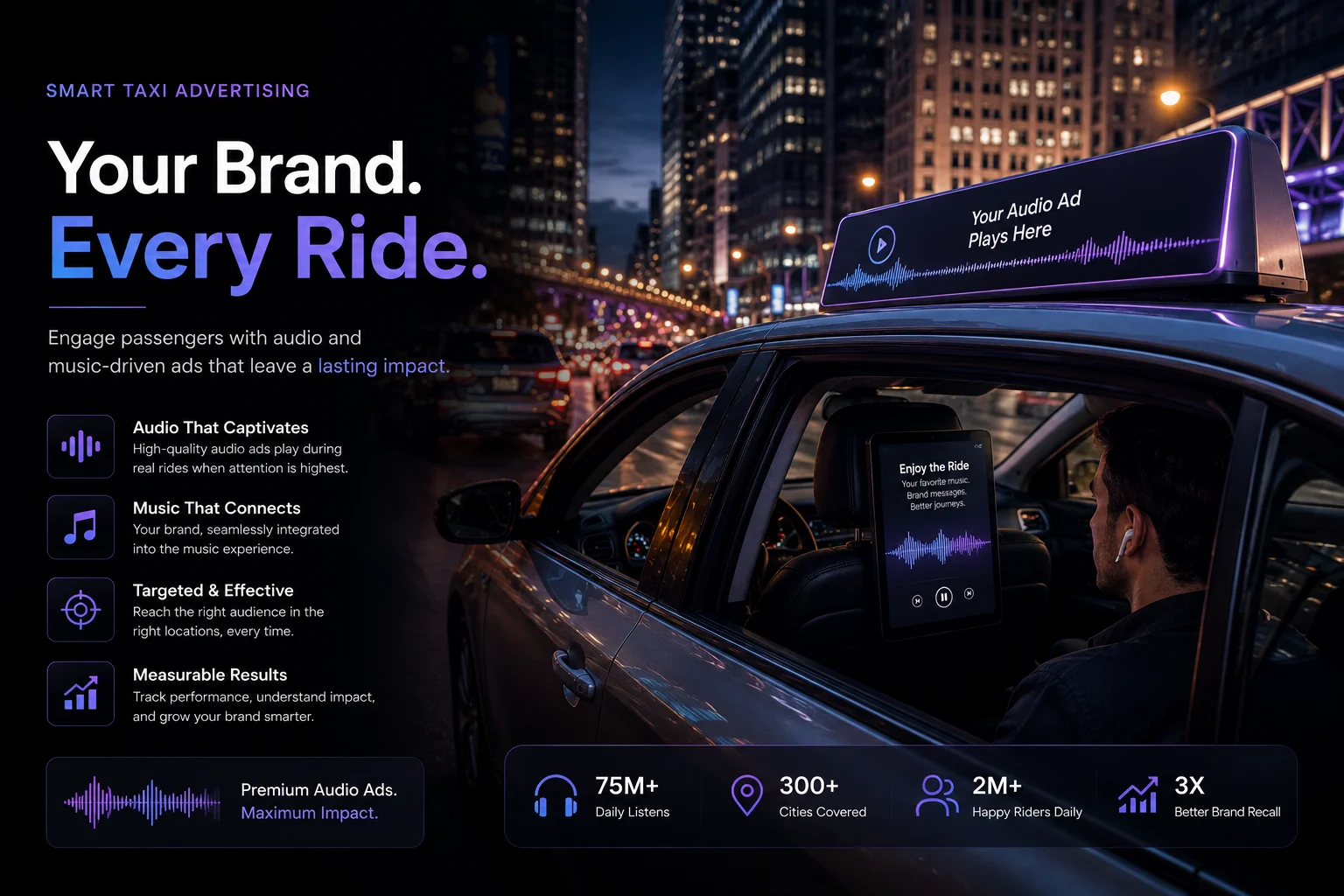
Passengers are highly engaged during rides, making in-cab advertising valuable for brand messaging. People often sit in a taxi for fifteen to thirty minutes with very few distractions. Advertising inside taxi cabs capitalizes on this captive audience. You can use digital screens mounted behind the headrests to play promotional videos. Seat-back ads provide printed reading material right at eye level. Many brands also incorporate QR code promotions, allowing passengers to scan a code with their smartphone to receive an instant discount or download an app.
Technology continues to reshape the OOH marketing landscape. Digital taxi ads include high-definition video ads played on interior screens or exterior digital displays. Advertisers can run interactive promotions that encourage riders to tap a screen to learn more. Some advanced systems even offer geo-targeted campaigns. In a geo-targeted setup, the ad changes based on the taxi's current location. App-connected advertising allows brands to sync their taxi ads with mobile applications, creating a seamless digital experience for the consumer.
Brands frequently choose mobile outdoor advertising over traditional static billboards because mobile ads deliver a dynamic presence. A static billboard only reaches the people who happen to drive down one specific highway. A taxi brings your message to every corner of the city.
Taxis naturally travel through high-traffic areas where people congregate. Because they go where the crowds are, they provide exposure to thousands of people daily. This hyperlocal visibility ensures your marketing budget is spent reaching actual people in your immediate service area, rather than empty rural roads.
Marketing budgets require careful management. When you compare billboards, TV ads, and print media against taxi advertising, the cost per impression strongly favors mobile OOH. Television ads require massive production budgets and expensive airtime slots. Traditional billboards lock you into high monthly lease rates in premium locations. Taxi ads give you city-wide exposure for a fraction of those premium costs, making it a highly cost-effective advertising strategy.
Urban environments are filled with diverse groups of people. A moving taxi ad reaches daily commuters walking to the subway. It catches the eyes of tourists exploring local landmarks. It is seen by office workers stepping out for a lunch break and event attendees leaving a concert. This broad audience reach is difficult to achieve with stationary ad placements.
Digital marketing comes with a major hurdle: ad blockers. People routinely skip YouTube ads, scroll past social media sponsored posts, and install software to hide banner ads. Unlike those digital formats, taxi ads cannot be blocked or skipped. A brightly wrapped vehicle driving down the street demands attention. This physical presence makes advertising on taxi cabs a highly reliable way to ensure your message is actually seen. This undeniable visibility is exactly why taxi cab advertising remains so successful.
Learning how to advertise on taxi cabs involves careful planning and strategic execution. If you want to advertise on taxi cabs and see a high return on investment, you must follow a few critical steps.
Every successful campaign starts with a clear objective. Are you trying to build general brand awareness in a new city? Perhaps you want to drive specific app downloads among commuters. You might be focusing on local promotion for a newly opened storefront, event marketing for an upcoming festival, or generating buzz for new product launches. Defining your goal will shape the design and messaging of your entire campaign.
Select a format that aligns with your specific goals. Exterior wraps work beautifully for broad visibility and brand awareness. Interior ads are perfect for passenger engagement and delivering complex information. Digital ads allow for interactive experiences and quick promotional changes.
While taxis move everywhere, you can often target fleets that operate in specific zones. Focus your campaign on downtown areas filled with corporate professionals. Target airports to reach business travelers and vacationers. Nightlife districts are excellent for food and beverage brands, while shopping zones offer great visibility for retail businesses.
Because taxis are often moving, your design must be immediately understandable. Use bold visuals and high-contrast colors to catch the eye. Keep your messaging short and easily readable from a distance. Include a strong CTA (Call to Action) telling the viewer exactly what to do next. If you are advertising inside the cab, utilize QR codes to bridge the gap between physical media and digital conversion. Always ensure your brand logo is prominent and easy-to-read.
Managing a fleet of branded vehicles requires specialized expertise. Businesses need a reliable advertising partner that simplifies campaign management and maximizes visibility. This is where a dedicated platform like DizzyApp steps in, offering the tools and network necessary to launch a flawless mobile campaign.
Taxi advertising works for both local and national brands. However, certain industries see particularly high engagement rates due to the nature of urban environments.
Hungry commuters and late-night travelers are highly receptive to food advertising. An image of a delicious meal on the side of a taxi can easily prompt a reservation or a delivery app order.
Local urgent care centers, dentists, and specialty clinics use taxi ads to remind the community of their convenient locations. Health messaging builds trust through repeated local visibility.
Tech companies thrive on urban early adopters. Advertising an app inside a taxi gives the passenger plenty of time to scan a QR code and download the software immediately.
Real estate agents and property management firms use vehicle branding to establish local dominance. Seeing a realtor's face on multiple taxis builds immense credibility in a specific neighborhood.
Concerts, theater productions, and local festivals use taxi cab advertising to generate rapid excitement. The bright lights of a taxi top ad pair perfectly with entertainment marketing.
Hotels, tour guides, and local attractions benefit heavily from airport taxi routes. Tourists often look to these vehicles for recommendations on what to do during their stay.
If your business falls into one of these categories, you should strongly consider how you can advertise on taxi cabs to capture local market share.
Managing an outdoor advertising campaign shouldn't be complicated. DizzyApp provides a streamlined approach to mobile marketing, making it easier than ever to get your brand on the road.
DizzyApp uses advanced tracking and analytics to ensure your campaign delivers real value. You can monitor where your ads travel and understand the true reach of your marketing investment.
Every business has different needs and budgets. DizzyApp offers interior ads for deep engagement, exterior branding for massive reach, and digital taxi promotions for dynamic messaging.
By placing your brand on active, moving vehicles, you intercept consumers during their daily routines. This proactive approach yields much higher engagement than waiting for customers to find you.
DizzyApp partners with extensive fleets that cover the most valuable commercial real estate in the city. Your ads will be seen exactly where commerce happens.
The platform removes the friction of traditional media buying. DizzyApp handles campaign setup, precise ad management, and targeted visibility, allowing you to focus on running your business while they handle the marketing logistics.
Even the best marketing channel can underperform if the creative execution is flawed. Avoid using cluttered ad designs. Trying to fit paragraphs of text on the side of a moving vehicle guarantees that nobody will read it. Always include a clear CTA; if people do not know what you want them to do, they will do nothing.
Do not choose the wrong target locations. Advertising a suburban lawn care service on downtown city taxis will result in wasted impressions. Maintain consistent branding across all your marketing channels so that your taxi ads match your website and social media profiles. Finally, avoid poor campaign timing. Do not launch a campaign for a summer festival in late autumn. Strategic planning is essential for maximizing your return on investment in taxi cab advertising.
The OOH marketing industry is rapidly modernizing. Digital taxi ads are becoming brighter, sharper, and more energy-efficient. AI-powered targeting is beginning to dictate which digital ads play based on the time of day, current weather, and local traffic patterns.
QR-based interaction will continue to grow, bridging the gap between the physical ad and the digital checkout cart. We will also see further integration into smart city advertising ecosystems, where taxi ads communicate with nearby digital billboards for synchronized brand takeovers. App-connected campaigns will allow passengers to interact directly with the taxi's screens using their own smartphones. Taxi advertising is evolving far beyond traditional outdoor advertising into a highly connected digital experience.
Mobile marketing provides an unparalleled opportunity to capture local attention. By choosing to invest in moving billboards, you ensure your message reaches consumers where they live, work, and play. The massive visibility, cost-effectiveness, and non-skippable nature of these campaigns make them a vital part of a modern marketing mix.
Whether you utilize a full exterior wrap or choose advertising inside taxi cabs to engage captive passengers, the results speak for themselves. Understanding how to advertise on taxi cabs allows you to bypass the noise of the digital world and place your brand directly in the real world. Encourage your marketing team to explore the smarter mobile advertising opportunities available with DizzyApp to take your brand visibility to the next level.
Yes, it is highly effective. Taxis constantly circulate through local neighborhoods, shopping centers, and business districts, ensuring that your marketing budget is spent reaching the exact people who live and work near your business.
Costs vary widely depending on the format, city, and campaign duration. An interior seat-back ad will cost significantly less than a full exterior vehicle wrap. However, it generally offers a much lower cost-per-impression than television or premium static billboards.
Businesses typically partner with a dedicated mobile advertising platform or fleet management company. These partners help design the creative materials, select the appropriate ad formats, install the ads on the vehicles, and track the campaign's performance.
Interior ads capitalize on a captive audience. Passengers are usually in the vehicle for extended periods, giving them plenty of time to read detailed messaging, watch promotional videos on digital screens, and scan QR codes to engage with your brand immediately.
While most industries can benefit, it is particularly powerful for restaurants, healthcare clinics, real estate agents, tech startups, and tourism-based businesses. These industries thrive on local visibility and immediate consumer action.
It offers a different, often more dynamic set of advantages. While a billboard reaches people driving past a single location, a taxi ad moves with the crowds, reaching pedestrians, commuters, and tourists across multiple neighborhoods throughout the entire day.